Accounts Payable Audit: What It Is, Checklist & Best Practices
A vendor emails to say they changed banks. The message looks right, the logo is there, and someone on your team updates the account number before the next payment run. Three weeks later the real vendor calls asking why they haven’t been paid.
Most payables problems look like that. Nobody notices them when they happen. They show up later, once the money is gone. An accounts payable audit is how you find them while there’s still time to do something about it: a structured look at who you pay, what you pay for and how the money leaves your account.
Quick summary
- An accounts payable audit checks that every bill was real, approved, correct and paid only once.
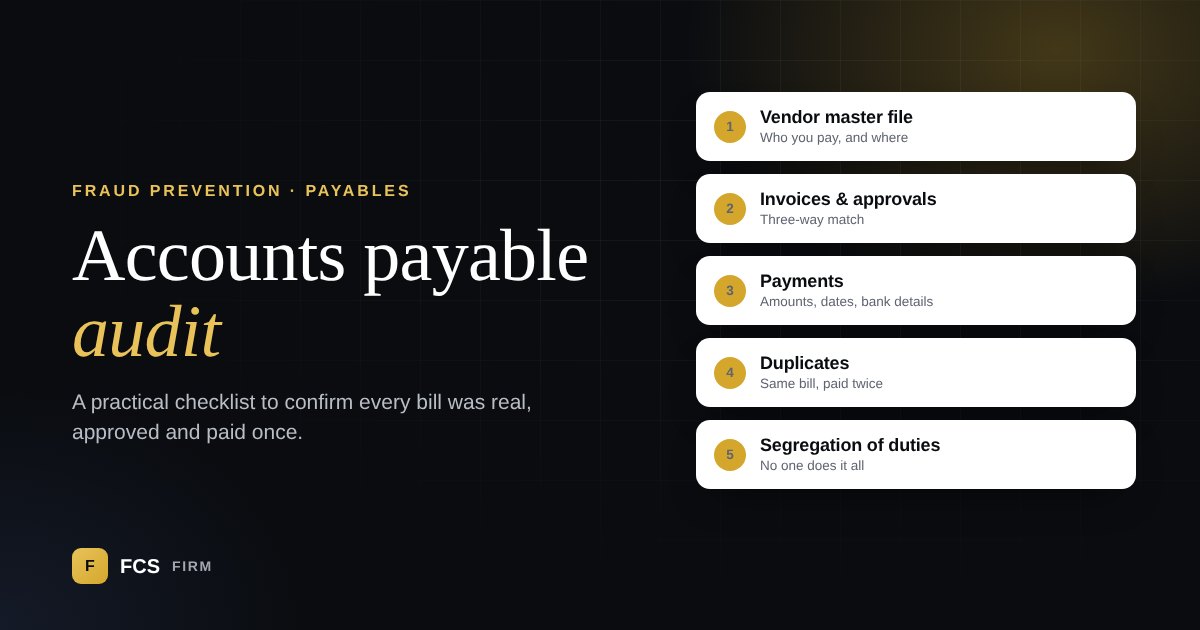
- It covers five areas: your vendor list, invoices and approvals, payments, duplicates and who does what.
- Billing schemes are one of the most common types of employee fraud, and small businesses aren’t spared: the median loss for companies under 100 employees was $141,000.
- A light monthly review plus a deeper yearly audit catches most issues before they get expensive.
What is an accounts payable audit?
Accounts payable is the money your business owes to vendors: suppliers, contractors, software subscriptions, rent, utilities. An accounts payable audit reviews those bills and the payments that settled them, and asks five simple questions about each one:
- Is the vendor real? And is it a vendor you actually chose to work with?
- Did you receive what you paid for? Goods arrived, service was delivered.
- Was the amount right? It should match the quote, the contract or the purchase order.
- Was it approved by the right person? Before the payment went out, not after.
- Was it paid once? Not twice, and not to the wrong account.
It’s worth separating this from a financial statement audit performed by a CPA firm. That kind of audit gives an opinion on your financial statements as a whole. An accounts payable audit is narrower and more practical. Its job is to protect cash and tighten the process, and you can run one internally or bring in an outside reviewer.
Why it matters more than most owners think
Payables are where money leaves the company, which makes them the natural target for both honest mistakes and fraud. The data on occupational fraud backs this up.
22%
of asset misappropriation cases involved billing schemes, with a median loss of $100,000 (ACFE, 2024).
$141K
median loss for organizations with fewer than 100 employees (ACFE, 2024).
12 months
is how long the typical fraud ran before anyone caught it (ACFE, 2026).
In its 2026 study of 2,402 fraud cases, the Association of Certified Fraud Examiners found that more than half involved either a lack of internal controls or someone overriding the controls that existed. Time matters, too: frauds caught in the first six months had a median loss of $40,000, while schemes that ran for more than five years passed $1.1 million.
None of this means your team is stealing from you. Most payables issues are plain errors: an invoice entered twice, a credit memo nobody applied, a subscription that should have been canceled a year ago. Still, it’s the same audit that catches the honest mistakes and the dishonest ones.
Accounts payable audit checklist
Work through these five areas in order. The first one is the most important, because a clean vendor list makes everything after it easier to verify.
Vendor master file
- Export the full vendor list and remove or deactivate vendors you haven’t paid in 12+ months.
- Look for duplicate vendors: same name with small spelling differences, same address, same tax ID or same bank account.
- Compare vendor addresses, phone numbers and bank accounts against employee records. A match deserves a closer look.
- Confirm you have a W-9 on file for every vendor that needs one.
- Review every change to vendor bank details in the period. Each change should have been verified by calling the vendor at a number you already had on file, never one from the email requesting the change.
Invoices and approvals
- Pull a sample of invoices, including the largest ones and a few picked at random.
- For goods, confirm the three-way match: purchase order, receiving record and invoice should agree on item, quantity and price.
- For services, confirm there’s a contract or written agreement and that the work was actually delivered.
- Check that each invoice was approved by someone with the authority to approve that amount, before it was paid.
- Watch for invoices just under an approval limit, round-number amounts and vague descriptions like “consulting” or “services rendered.”
Payments
- Match each payment in the bank statement to an approved invoice. Payments without an invoice are the first thing to explain.
- Confirm the payee name and bank account match the vendor master file.
- Review manual checks, wire transfers and rush payments separately. They skip the normal flow more often.
- Look at payments made on weekends, holidays or outside the regular payment run.
- Check that early-payment discounts were taken when offered and that late fees weren’t paid without reason.
Duplicate payments
- Sort payments by vendor and amount, then look for repeats within a short window.
- Compare invoice numbers that are almost identical: INV-1045 vs. INV1045, or an extra zero or letter.
- Check for the same invoice paid once by check and again by ACH or card.
- Review vendor statements for credits or overpayments sitting on their side that were never refunded.
Segregation of duties and access
- Map who can add vendors, enter invoices, approve bills, release payments and reconcile the bank account.
- No single person should be able to create a vendor and pay that vendor without someone else seeing it.
- Review user access in your accounting software and bank portal. Remove former employees and anyone with more access than their role needs.
- Confirm the bank reconciliation is done by someone who doesn’t process payments, and that it’s done every month.
In practice
If you only have one hour, spend it on the vendor master file and bank detail changes. Export the vendor list into a spreadsheet, sort by bank account number, and look for two vendors sharing an account or a vendor sharing an account with an employee. It’s one of the fastest checks there is, and it covers one of the costliest risks.
Red flags to look for
One of these on its own doesn’t prove anything. They’re signs to stop and ask a question before moving on.
| What you see | What it may mean |
|---|---|
| Vendor with only a P.O. box and no phone | Shell or fictitious vendor |
| Invoices just under the approval limit | Someone avoiding review |
| Sequential invoice numbers from one vendor | You may be its only “customer” |
| Recent bank detail change by email | Vendor impersonation attempt |
| Same amount paid twice in a week | Duplicate payment |
| Rising spend with no change in volume | Overbilling or kickbacks |
| One employee who won’t share their tasks | Control gap worth reviewing |
That last one deserves a note. The ACFE found that 84% of fraud perpetrators showed at least one behavioral red flag before they were caught, such as being unusually close with a vendor or refusing to take vacations. Nobody should be accused because of a pattern. Still, a process where only one person knows how payables work is a risk, even when that person is completely honest.
How often should you audit payables?
For most small and mid-sized businesses, a rhythm like this works well:
- Monthly: a light review. Reconcile the bank, scan the payment register for duplicates and look at every vendor added or changed that month.
- Yearly: a full audit using the checklist above, ideally before year-end close and tax season.
- Unannounced: a few spot checks during the year. Pick a week at random and trace every payment back to its invoice and approval.
The unannounced part matters more than it seems. In the ACFE’s 2024 data, organizations that used surprise audits had median fraud losses 63% lower and caught schemes in half the time compared to those that didn’t. Proactive data monitoring showed a similar effect, with losses and duration both cut roughly in half.
Best practices to keep payables clean
An audit finds what already went wrong. These habits keep the next audit short:
- Lock down vendor changes. Any new vendor or bank detail change needs a second person and a callback to a known number.
- Pay only from approved invoices. No invoice, no approval, no payment. That includes “urgent” requests from the owner’s email.
- Use a single, consistent invoice number format when entering bills, so your accounting software can flag duplicates.
- Set clear approval limits and require two approvals above a certain amount.
- Separate duties, even in a small team. If you can’t split roles, add an owner review of the payment register every week.
- Review vendor statements at least quarterly to catch credits and missing invoices.
- Automate the boring checks. Rules that flag duplicate amounts, new bank accounts or payments outside the normal run catch issues the same day instead of months later.
A note of caution
If your review turns up something that looks like fraud, don’t confront anyone and don’t delete or change records. Preserve the documents, limit who knows, and talk to an attorney or a qualified fraud examiner before taking action. How you handle the first few days can affect your ability to recover the money.
SmartFlow™ Protection
Want a second set of eyes on your payables?
FCS Firm reviews your vendor list, approvals and payment history, flags duplicates and anomalies, and helps you set up controls that keep catching them automatically.
Frequently asked questions
What is an accounts payable audit?
It’s a review of the bills your business received and paid, to confirm each payment went to a real vendor, for goods or services actually received, at the agreed amount, with the right approval, and only once.
How often should a small business audit accounts payable?
A light monthly review plus a deeper review once a year works for most small businesses. Unannounced spot checks during the year add a lot of protection for very little effort.
What is a three-way match?
It means comparing three documents before paying: the purchase order (what you ordered), the receiving record (what actually arrived) and the vendor invoice (what you’re being charged). If the three agree, the bill is ready for approval.
How do you find duplicate payments?
Export your payment history and look for the same vendor with the same amount, the same or very similar invoice numbers, or payments a few days apart. Small variations like a missing dash or an extra zero in the invoice number are a common way duplicates slip through.
Who should perform an accounts payable audit?
Ideally someone who doesn’t enter or pay bills day to day: an owner, a controller, an outside bookkeeper or a consulting firm. The point is a fresh set of eyes with no stake in the transactions being reviewed.
Sources
- Association of Certified Fraud Examiners, Occupational Fraud 2026: A Report to the Nations — key findings.
- Association of Certified Fraud Examiners, Report to the Nations, 2024 edition (billing schemes, organization size and anti-fraud controls data).
About this article: this content is for general educational purposes and is not legal, tax or accounting advice. Every business is different, so talk to a qualified professional about your specific situation.